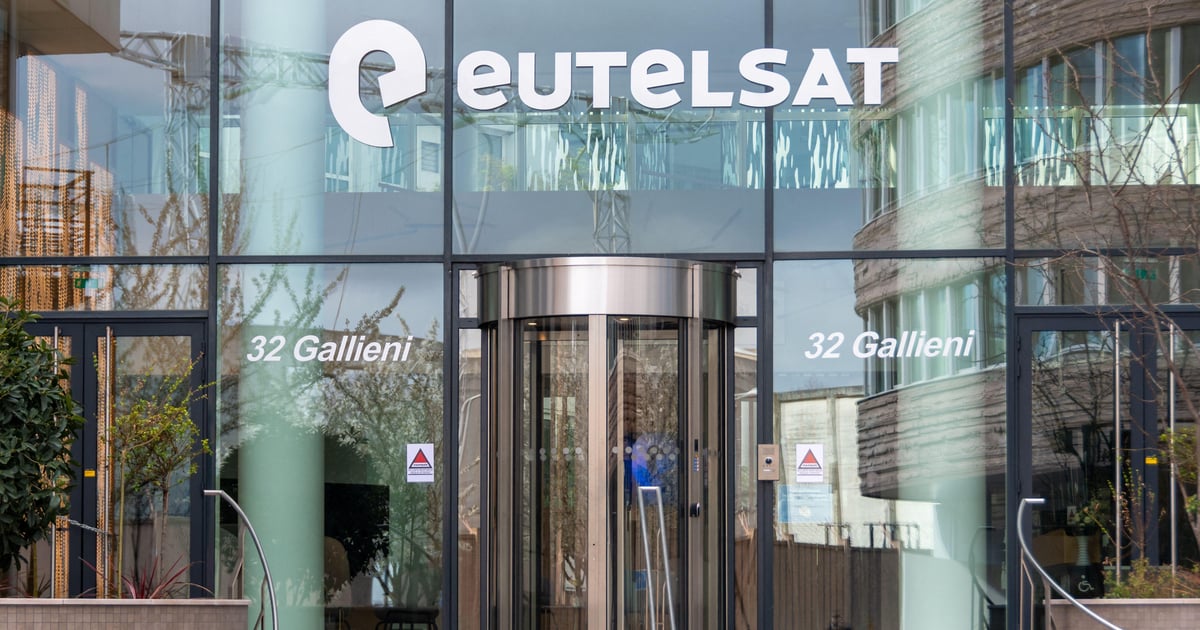
Satellite5GRegulatory & PoliticsBroadbandNewsEutelsat hails 5G NTN to take on 'American giants'Eutelsat CEO Jean-François Fallacher talked up 5G NTN tech in the EU's expanded sovereign satellite project to rival the likes of Starlink and Amazon Leo.Michelle Donegan,Senior Editor, Light ReadingAugust 7, 20265 Min Read(Source: HJBC/Alamy Stock Photo)The starter pistol was fired this morning for Europe's bid to build a sovereign satellite constellation for critical communications, according to Eutelsat CEO Jean-François Fallacher.The European Commission announced the next steps for the IRIS2 program after reaching an implementation agreement with the prime contractors, one of which is Eutelsat, as Fallacher delivered the company's earnings results for fiscal full-year ending June 30.The EC agreed terms with the SpaceRISE consortium – comprising Eutelsat, Hispasat and SES – for deploying the satellite system, which includes adding 66 more low-Earth orbit (LEO) satellites dedicated to defense, security and emergency services, and launching services from 2029.Fallacher said this is "a very important milestone" that moves the project on from design and preparation to an "operational phase" and confirms Eutelsat's role as the program's "LEO lead."Related:5G looks lost in space without new satellites and devicesThe expanded constellation will have a total of 348 satellites, of which 18 will be in medium-Earth orbit (MEO), supplied by SES, and 330 LEO craft from Eutelsat.IRIS2 is sometimes described as Europe's answer to Starlink. It is no secret that part of the motivation to build the satellite system is to reduce reliance on US satellites providers, especially for sensitive military and government communications.Fallacher shared a high-level view of some of the system's new technology that is hoped to give it an advantage over larger US rivals. He said the multi-orbit MEO-LEO constellation is "very advanced," and will have "much more" capacity than OneWeb today.He also confirmed it will be based on 5G non-terrestrial network (NTN) standards, which is "important.""We use 5G NTN technology.
For IRIS2, we want to normalize the technology ... This is also a way to fight against the American giants because today each of the technology used by ourselves on OneWeb, by Amazon or by Starlink are full proprietary technologies," he said. "Going to normalized technologies such as 5G NTN will also help [in] bringing the cost down [and] having antennas which will be cheaper and of a smaller size."EU vs USThe advance in the IRIS2 project follows the recent EC decision to reserve most of the prized 2GHz mobile satellite spectrum band to European companies, with one-third allocated to IRIS2.
Both moves show how the EU is keen to strengthen Europe's own satellite capabilities."Ukraine's use of Starlink on the front line has highlighted how important satellite communications will be in future warfare. The EU is understandably keen not to be reliant on its US partners for this capability," said Luke Pearce, principal analyst at FDM CCS Insight.Related:Europe moves ahead with strategies to take on StarlinkThe EU's moves have sparked from backlash from across the pond. Writing on X, FCC Chairman Brendan Carr hinted that if Europe placed limits on US satellite operators, then the regulator would do the same to those operating in the US, in the spirit of the agency's "reciprocity" approach.
SpaceX has reportedly urged the FCC to look into Eutelsat's recent request to deploy more satellites following the EC's spectrum decision, according to PCMag.The main use of the IRIS2 system will be military and government connectivity, but the SpaceRISE consortium members can also use part of it for their own commercial services.Pearce doubts the project can catch up to Starlink, or even Amazon's planned rollout.IRIS2 has been "marred by significant uncertainty and scrutiny" since it was announced in November 2022, and "at times, the project has appeared destined to fail," he said. Initial services were supposed to launch in 2024. Now, the full system is likely to arrive in 2030 or later, he explained."It is therefore materially behind Starlink and will almost certainly remain so.
By the time IRIS² is operational, SpaceX will have moved through further generations of satellites, terminals and services. Amazon Leo will also be a much more established competitor," said Pearce.Related:Eutelsat changes CEO amid pressure to compete with StarlinkHe also said the use of 5G NTN was "not surprising.""Using standardized technology should broaden the equipment ecosystem, improve interoperability with terrestrial networks and ultimately bring costs down. However, 5G NTN is not a silver bullet.
Standardization alone will not overcome the US's enormous lead in satellite manufacturing, launch capabilities, terminals and overall scale," said Pearce.The low-down on LEO for IRIS2Eutelsat, which also operates 31 geostationary orbit (GEO) satellites, gained its LEO constellation with the acquisition of OneWeb in 2023. It is a distant second LEO operator with around 650 satellites, compared to Starlink's more than 10,000.They both operate LEO constellations, but Eutelsat has a "fundamentally different constellation with different target customers, business models and scale," according to Pearce.LEO connectivity accounted for 25% of Eutelsat's total revenue of €1.23 billion (US$1.41 billion) for the fiscal year ending June 30, and LEO revenue grew 70% year-over-year.For IRIS2, Eutelsat will design and operate 264 dual Mil-Ka/Ku band and 66 Mil-Ka band satellites. The company said it will invest €2.23 billion ($2.57 billion) in the shared infrastructure and €1.16 billion ($1.34 billion) in the commercial infrastructure (which includes Ku payload and commercial ground equipment), with spending phased from 2027 to 2034.According to its concession agreement with the EC, the company said it expects revenue from IRIS2 activity to be more than €10 billion ($11.6 billion) from 2032 to 2040.The Ka-only satellites are planned to start launching in 2029, while the commercial Ku LEO system is expected to be operational by mid-2032.Eutelsat also said it plans to add 229 satellites to OneWeb through 2034 in addition to 440 new first-generation satellites for an investment of €1 billion ($1.2 billion).Read more about:EuropeAbout the AuthorMichelle DoneganSenior Editor, Light ReadingMichelle Donegan covers all things 5G, 6G and mobile tech for Light Reading.
She has been writing about the telecoms sector since the early 1990s.Her first job was with Global Telephony magazine in Chicago, where she got an intro to publishing and tech reporting. After moving to the UK in 1999, she has covered telecoms tech, business and policy issues at publications including Communications Week International and Total Telecom. She was also part of Light Reading’s European editorial team from 2007 to 2013.
Between stints at Light Reading, she was busy freelancing and was a regular contributor to Mobile Europe, Mobile World Live, TelcoTitans, TM Forum, and more.See more from Michelle DoneganWant more Light Reading stories in your Google search results?Add Us NowSubscribe and receive the latest news from the industry.Join 62,000+ members. Yes it's completely free.Sign me up5GFeatured StoryAT&T puts 600MHz to work with Ericsson for coverage and uplinkAT&T to roll out Ericsson dual-band radios with 'uplink-enhancing' technology in newly acquired 600MHz spectrum from EchoStar.MoreFiber Connect | May 17-20, 2026 | Orlando, FLFiber Connect is the largest fiber broadband event in the world. This year’s program will articulate how fiber broadband positions communities “Light Years Ahead” in terms of access to beneficial digital applications and services.
Sessions will showcase the future fiber enables and best practices for building and expanding fiber infrastructure. If prompted, use code MEDIA for free registrationRegister your team here