Text settings Welcome to Edition 8.40 of the Rocket Report! One of the remarkable things about SpaceX is that, after a quarter of a century and becoming the most important launch company of this era, it remains a disruptive force. Even though the Falcon 9 is the most used rocket of the world, and groundbreaking in its reuse capabilities, SpaceX is actively seeking to make it obsolete with the Starship program.
Stephen has a great story in this week’s newsletter highlighting the fact that we’re probably past the peak of the Falcon era of flight. As always, we welcome reader submissions, and if you don’t want to miss an issue, please subscribe using the box below (the form will not appear on AMP-enabled versions of the site). Each report will include information on small-, medium-, and heavy-lift rockets as well as a quick look ahead at the next three launches on the calendar.
Firefly readies for upgraded Alpha rocket launch. Firefly Aerospace plans to debut the upgraded version of its Alpha rocket late this summer, Space News reports. In a May 4 earnings call about the company’s first-quarter financial results, Jason Kim, chief executive of Firefly, confirmed the company was moving ahead with the Alpha Block 2 rocket after a successful return to flight of the original version of the vehicle in March.
Block 2 coming for you … The company announced the Block 2 version of Alpha in January, with stretched first and second stages and upgrades to avionics, batteries, and its thermal protection system. The company said the upgrades were intended to improve the reliability of the vehicle, which suffered two failures and two partial failures in its first six launches.
He did not disclose the customer for the Flight 8 mission, but said the company was planning two more launches after that this year. Orbex was losing nearly $3 million a month. Orbex, the rocket company behind plans for the Sutherland Spaceport in Scotland, collapsed earlier this year after failing to secure fresh funding, The Northern Times reports.
According to the filing lodged at the end of April, the company was losing around 2 million pounds ($2.7 million) a month before entering administration in February. By that point, total losses had reached about 73 million pounds ($100 million). No buyers …
The filing shows Orbex had 163 staff and had been working on two rocket systems: the Prime micro-launch vehicle, which was in development, and a larger system called Proxima, still at the design stage. In 2025, Orbex attempted to raise additional capital through a Series D funding round, but this was unsuccessful. Earlier this year, as many as 69 parties expressed interest in buying Orbex, but all discussions fell through.
Rocket Lab posts record revenue. In its first-quarter financial results for 2026, Rocket Lab reported a record revenue level of more than $200 million. This was a 63 percent increase over the first quarter of last year.
The publicly traded company also said it had a $2.2 billion backlog and has $2 billion in liquidity that will enable it to make further acquisitions. During the first quarter the company completed its acquisition of Mynaric AG, a leading provider of laser optical communications terminals. Lots of launch contracts …
The company said it signed 31 new Electron and HASTE contracts during the quarter, plus five new dedicated Neutron launches. Rocket Lab has now sold more launches in Q1 2026 than in the full year of 2025. From all appearances, Rocket Lab is continuing to grow as both a formidable launch and space services company.
Have we passed peak Falcon 9? It is far too soon to mention retirement, but astute observers of the space industry have noticed SpaceX’s workhorse Falcon 9 rocket is not launching as often as it used to, Ars reports. The decline is modest so far, and it does not signal any problem at SpaceX or with the Falcon 9.
Rather, it is a manifestation of SpaceX’s eagerness to shift focus to the much larger Starship rocket, an enabler of what the company wants to do in space: missions to land on the Moon and Mars, orbital data centers, and next-gen Starlink. Elon Musk’s SpaceX conducted 165 launches with the Falcon 9 rocket (no Falcon Heavy missions) last year, up from 134 Falcon 9 and Falcon Heavy launches in 2024 and 96 Falcon flights in 2023. Moving away from one of two Florida launch pads …
The company plans “maybe 140, 145-ish” Falcon launches in 2026, according to SpaceX President Gwynne Shotwell. The changes are most apparent at Cape Canaveral, Florida. Until last December, SpaceX launched Falcon 9s with regularity from two pads on Florida’s Space Coast—one at NASA’s Kennedy Space Center and another a few miles to the south on military property at Cape Canaveral Space Force Station.
SpaceX is transitioning the site at Kennedy, known as Launch Complex-39A, to launch Starships. LC-39A is out of the rotation for Falcon 9 launches. ESA may move launch from Vega C to Ariane 6.
In October 2024, the European Space Agency awarded OHB a 280 million euro contract to develop and build a pair of satellites for its Harmony mission. European Spaceflight recently looked into how this payload will reach orbit. ESA confirmed Vega C as the mission’s baseline launch vehicle during a presentation given by Project Manager Florence Hélière at the agency’s Living Planet Symposium in June 2025.
Hélière explained that both satellites would be launched in 2029 aboard a single Vega C Block 2, which features the P160C booster upgrade. She also indicated that cost constraints had helped shape the decision to select a single Vega C launch for both satellites. P160C upgrade when? …
However, last month, ESA published an RFI inviting Arianespace to provide “non-binding information on Ariane 62 launch services for the Harmony mission in Q4 2029 / Q1 2030.” This suggests that ESA may be concerned about whether Vega C Block 2 will be available in time to support the launch. In January 2026, an ESA spokesperson told the publication that there was no urgency to complete the P160C upgrade for Vega C. Armstrong prize goes to SpaceX reusable team.
Purdue University awarded its inaugural Neil Armstrong Space Prize to the Falcon 9 Booster Landing Team for its work to develop the reusable first stage of the rocket. The eponymous award honors aerospace pioneer and Purdue graduate Neil Armstrong (BS aeronautical engineering ’55, honorary doctorate ’70). Chosen for impact to humanity …
The Falcon 9 team was chosen from a long list of impressive nominees. “In the end, the deciding factor was what we felt like was the team’s impact to humanity,” said Dan Dumbacher, chair of the Neil Armstrong Space Prize selection committee. “Their work has had a very clear impact and a very visible impact.” Hard to disagree with that. Chinese firm pursues aerodynamic recovery. Chinese commercial launch startup Nayuta Space has completed consecutive Pre-A financing rounds to support development of its unconventional Xuanniao-R rocket concept, Space News reports.
The two-stage, 70-meter-long, 3.8m-diameter Xuanniao-R launcher features an aerodynamic deceleration and horizontal landing approach to reusability, with Nayuta targeting a debut test flight of the Xuanniao-R in the first half of 2027. Probably not going to meet that target … While Nayuta Space claims its aerodynamic deceleration approach can reduce the dependence on a launcher engines’ reignition, propulsive braking, and high-precision control capabilities for vertical recovery, the approach will demand new aerodynamic structures, bringing challenges, including increased weight and complexity.
The size of the launcher, the novel and unproven approach, and uncertain funding levels suggest that the 2027 timeline for a debut flight is very ambitious. New record set for safe booster landings. On Tuesday, SpaceX launched another routine Falcon 9 mission from Vandenberg Space Force Base in California, putting yet another batch of Starlink v2-mini satellites into orbit.
It was the 611th successful recovery overall of a Falcon booster. That’s a lot of landings … However, a writer at NASASpaceflight.com, Alex Alcantarilla Romera, noted that this actually represents a significant milestone.
With this landing, SpaceX has set a record for consecutive successful booster landings at 268. This matters because with its Starship program, SpaceX ultimately aims to land humans back on Earth via vertical landing, and demonstrating a sustained record of success with this method builds confidence in this technology. Starship nearing Flight 12.
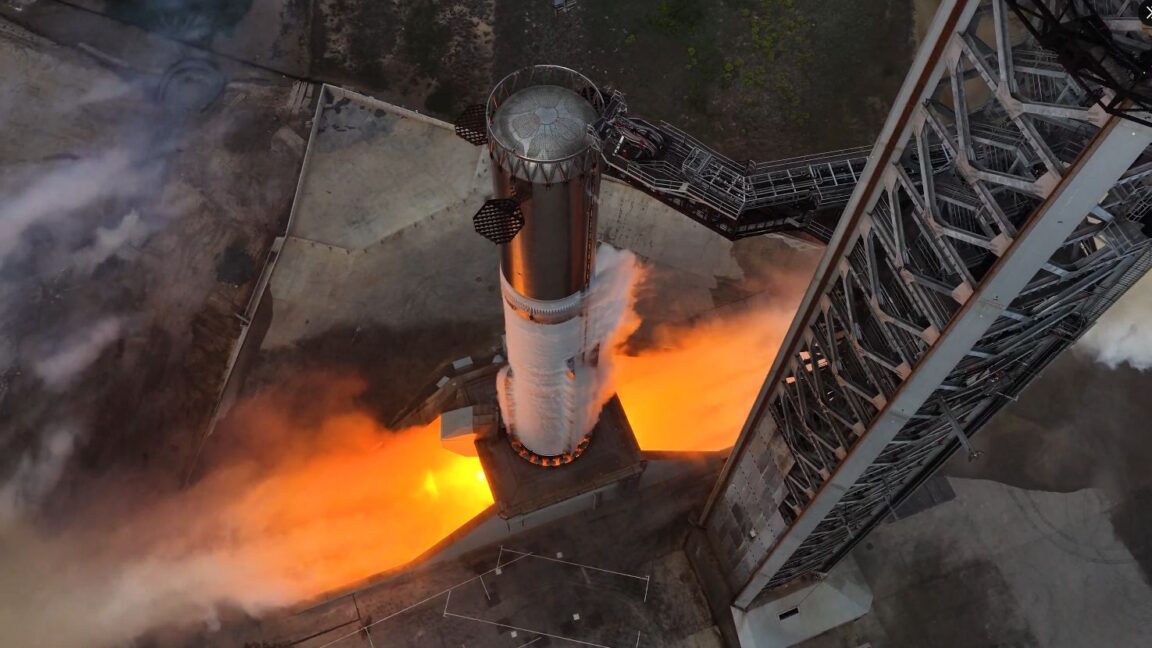
SpaceX on Thursday conducted a 15-second test firing of the Super Heavy booster stage for its Starship launch vehicle, and it appeared to go well based on independent videos of the test. This was a critical test in the campaign to ready the newest iteration of Starship, V3, for its debut launch. SpaceX has not announced a launch date, but mid-May appears possible.
More testing ahead … Next up for the company is moving the Starship upper stage to the launch site at Starbase, Texas. There, the vehicles will be integrated into a full stack and will likely undergo further testing before a launch attempt.
Starship V3 is needed to begin demonstrating in-orbit refueling, an enabling capability for turning Starship into a human-rated Moon lander for NASA’s Artemis program. South Texas residents sue over Starship noise. As SpaceX prepares for the first flight of V3 of its Starship vehicle, the company is facing a new legal challenge from local residents who claim its launches damage their homes, Space News reports.
The environmental impacts of Starship launches from Starbase, located on the Gulf Coast of Texas near the Mexico border, have been scrutinized for years. SpaceX has secured environmental approvals from the federal government for Starship launches, although some local residents as well as environmental advocates have opposed the launches. Concerned about intense engine noise …
The latest salvo in that debate was a lawsuit filed in US District Court in the Southern District of Texas on April 30 by dozens of residents against SpaceX. In the suit, they claim their homes suffered damage from previous Starship launches. The plaintiffs, who primarily live in the cities of Port Isabel and South Padre Island, the two closest communities to Starbase, argue that the intense engine noise of both Starship’s liftoff and the return of the Super Heavy booster, along with sonic booms, caused damage to their homes.
The complaint does not give specific examples of the damage. Next three launches May 11: Long March 7 | Tianzhou 10 | Wenchang Space Launch Site, China | 00:14 UTC May 11: Falcon 9 | NROL-172 | Vandenberg Space Force Base, California | 22:28 UTC May 12: Long March 6A | Unknown payload | Taiyuan Satellite Launch Center, China | 11:55 UTC Eric Berger Senior Space Editor Eric Berger Senior Space Editor Eric Berger is the senior space editor at Ars Technica, covering everything from astronomy to private space to NASA policy, and author of two books: Liftoff, about the rise of SpaceX; and Reentry, on the development of the Falcon 9 rocket and Dragon. A certified meteorologist, Eric lives in Houston.
14 Comments